
Spring Rain and Distracted Drivers: Why April Fender Benders Spike on Long Island
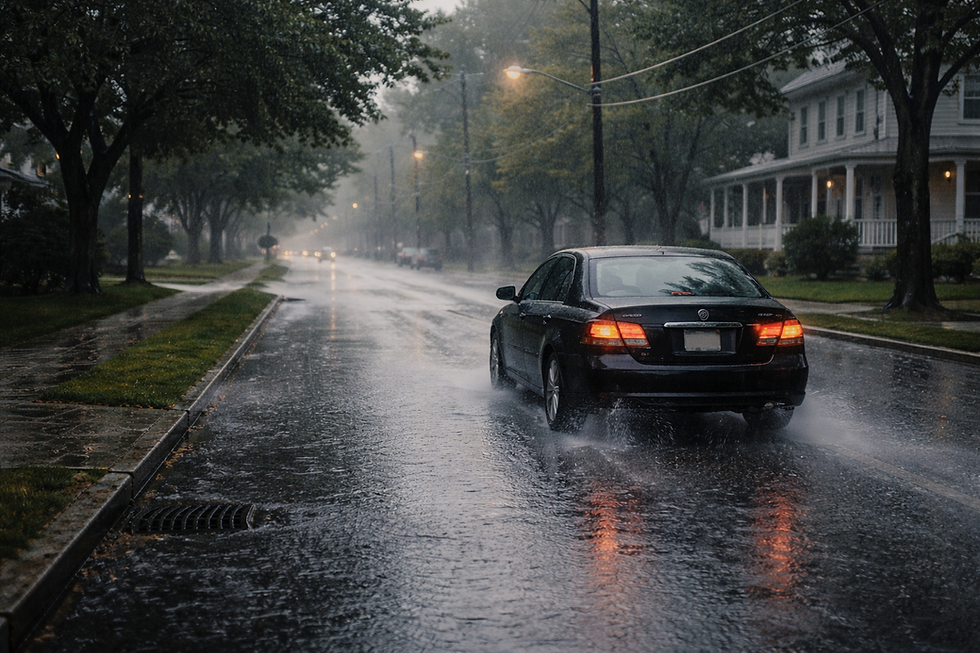
April is one of the rainiest months of the year on Long Island. Temperatures are reasonable, people are back outside, and traffic volume is climbing after the slow winter stretch. Add persistent rain to that equation, and you get one of the higher-risk months for low-speed collisions.
Fender benders spike in April across Nassau County every year. Most happen at under 25 mph, many in parking lots or on surface roads, and a significant number involve damage that looks manageable on the outside but is not.
What Rain Does to Stopping Distance
Wet pavement does not just make roads slippery in the obvious sense. It increases the distance a vehicle needs to stop, and it does so faster than most drivers account for. At 40 mph on dry pavement, a typical passenger car can stop in roughly 150 feet. On wet asphalt, that number climbs, and it climbs further when tires are worn or underinflated.
The problem is the following distance. Most drivers do not adjust it when it rains. The car in front stops, the car behind does not have enough room, and a rear-end collision that would never have happened on a dry road occurs anyway.
New York State law requires headlights whenever windshield wipers are in use, day or night. That requirement exists for a reason. In the rain, the vehicles most likely to get hit are the ones that are hardest to see.
Spring Traffic Brings Its Own Risks
April is also the month when road users reappear. Cyclists, motorcyclists, and pedestrians who stayed off the roads through winter are back. School zones get busier after spring break. Drivers who spent months in a relatively predictable winter routine are suddenly sharing lanes with a more varied mix of traffic.
Parking lots become collision hotspots in spring, specifically because volume is up and driver attention tends to drop at low speeds. Most parking lot impacts occur at 10 mph or less, which means they rarely get reported, but that does not mean the damage is minor.
What a Low-Speed Collision Actually Damages
The bumper cover is the painted plastic piece visible from outside the car. Behind it sits a foam energy absorber, and behind that is a steel or aluminum reinforcement bar that connects to the vehicle structure. A rear-end impact at 10 to 15 mph can crack or crush the cover, compress or shatter the absorber, and bend the reinforcement bar, all without leaving marks obvious enough to catch at a glance.
In some cases, the impact pushes further. A harder hit can misalign a trunk lid, crack a taillight housing, or affect the rear frame rails in a unibody vehicle. Drivers often notice something is off later: a trunk that does not close cleanly, a shimmy at highway speed, or a warning light that appears a week after the incident.
Sensor damage is increasingly common and increasingly costly. Backup cameras, parking sensors, and rear-facing radar systems for adaptive cruise or collision warning are mounted in or directly behind the bumper assembly. A fender bender can knock them out of alignment or damage them entirely without any visible indication at the impact point.
When to Get It Inspected
A visual check is not a substitute for a professional assessment. If a collision felt harder than it looked, if anything about the car's behavior has changed afterward, or if any warning lights have appeared, the vehicle should be evaluated by a technician who can check alignment, sensor function, and structural integrity, not just the surface.
Castle Collision's I-CAR Gold-certified technicians assess the full picture after a collision. When rear impacts affect the structure, our Frame and Unibody Straightening process restores factory alignment before bodywork begins. Parking lot dents and scrapes that do not involve paint damage are often candidates for Paintless Dent Removal, which repairs the panel without disturbing the factory finish.
Free estimates, no appointment necessary. We work with all major insurance carriers and handle the claims process from our Westbury location. Our Complete Collision Repair process is backed by a lifetime warranty.
Call Castle Collision at 800-246-3368 or visit our contact page to schedule an inspection.


Nice
Fuel Fixer